THE IMAGE PROBLEM
Rotary GB&I was widely described internally as "old, male, stale and pale." Interviewees recognised that the image needed modernising and that a membership, marketing, and PR strategy was essential to attract diverse new members.


Rotary GB&I is one of the world's most respected civic organisations. At the time of the 2022 study, Rotary had approximately 1.4 million members across more than 200 countries. In Great Britain and Ireland, however, Rotary faced a stark reality: clubs where all members were male, clubs where all members were over 70, and a membership base that did not reflect the communities it served.
WAF was commissioned to determine a clear pathway for Rotary GB&I to address its diversity and inclusion challenges, both internally and externally. The work covered internal research, external audience research, membership journey analysis, policy review, community mapping, and DE&I training needs analysis across the organisation.
WAF delivered Phase 1 of a comprehensive DE&I programme for Rotary GB&I, structured around five workstreams.
Advice and guidance for reaching diverse local audiences at the national volunteering expo, helping Rotary GB&I present itself credibly to communities it had not previously engaged.
Fifteen 45-minute in-depth interviews with Rotarians and central office employees from across GB&I locations and roles, uncovering honest perspectives on what was and was not working on diversity and inclusion.
Focus groups to understand general market awareness and opinions of Rotary GB&I among diverse communities, along with the barriers and motivators to joining.
Identification of key community groups that Rotary GB&I could engage with to increase presence, membership, and support among underrepresented populations.
A full training needs analysis across all roles within Rotary GB&I, identifying gaps and recommending a structured approach to building inclusive behaviours at every level.
The internal interview programme produced candid, often uncomfortable findings. There was genuine love for Rotary and the contribution it makes to society. There was also a clear reckoning with how far the organisation needed to go.
Research voice 01
“The image of Rotary is old, male, stale and pale.”
Research voice 02
“There is no attraction for people to join Rotary, diverse or not.”
Research voice 03
“Retention, especially at the early stages is a big issue.”
Rotary GB&I was widely described internally as "old, male, stale and pale." Interviewees recognised that the image needed modernising and that a membership, marketing, and PR strategy was essential to attract diverse new members.
Even when diverse individuals joined, many did not feel welcome. Progression was based on tenure rather than ability, with no proactive talent spotting. Interviewees described experiences of exclusion, racist banter going unchallenged, and a culture that made diverse members feel invisible.
There were no mandatory DE&I goals for districts, no metrics to measure progress, and inconsistent information sharing across clubs. Some clubs were exemplary, others were actively blocking change.
Leadership sincerity on DE&I was questioned by some interviewees, with concerns that efforts were tokenistic. Frequent leadership changes meant initiatives often stalled before implementation. The old guard were identified as active blockers to progress.
WAF conducted a full review of the Rotary GB&I membership journey, from initial Google search through to submission of interest. The findings identified several practical barriers that were actively preventing diverse new members from even reaching the point of joining.
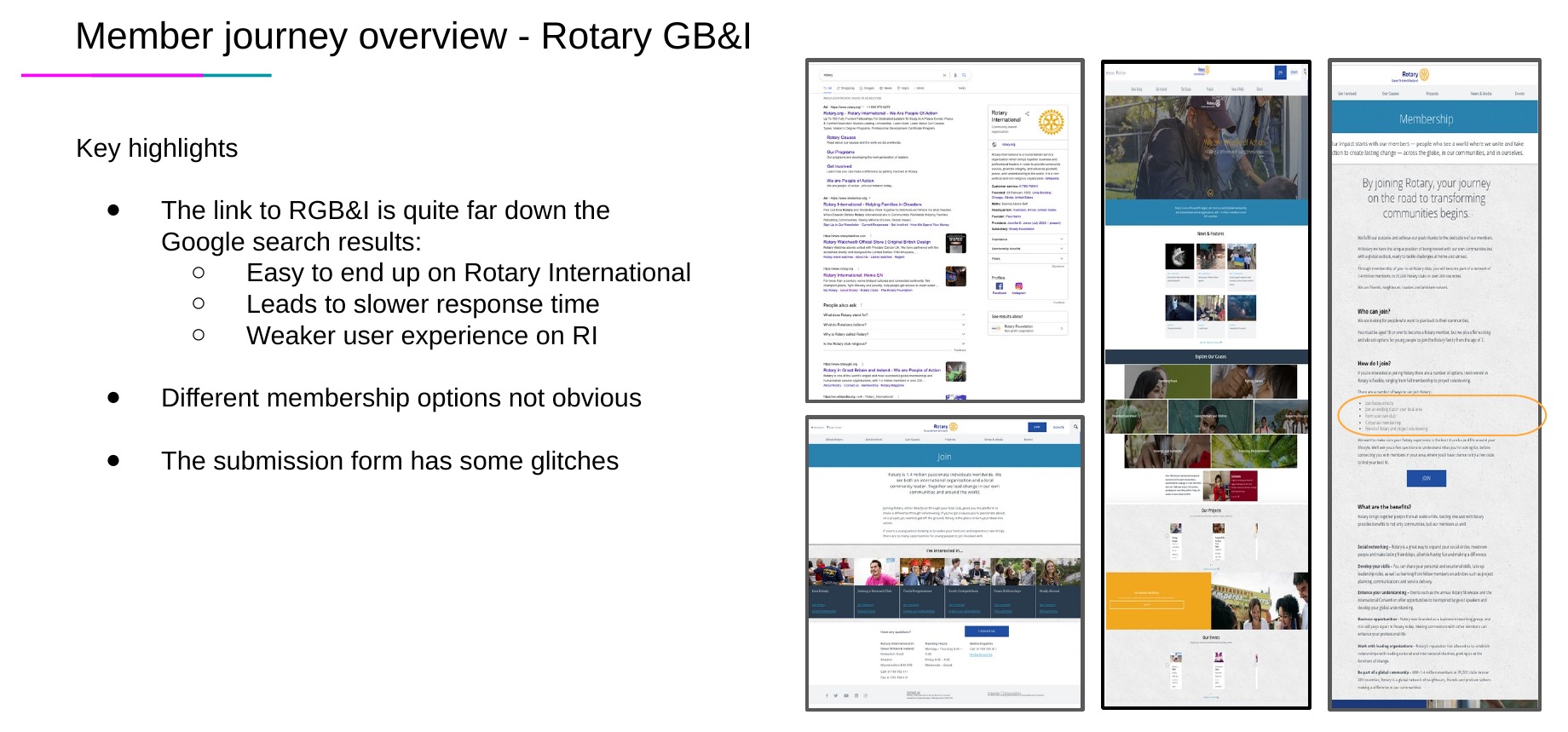
The Rotary GB&I website appeared far down Google search results, making it easy for prospective members to land on the international Rotary site instead, creating a slower and weaker user experience.
Different membership types, including direct membership and corporate options, were not prominently explained, meaning prospective members could not quickly understand how Rotary could fit their life.
The submission form had technical issues, including the inability to move easily between sections and a Submit button that did not respond. First impressions at the most critical moment were failing.
WAF's Phase 1 findings produced a structured set of recommendations across four priority areas, each requiring structural, technological, policy, and behavioural change.
A full membership, marketing, and PR strategy targeting underrepresented groups. New membership options including corporate and direct routes. Social media used strategically to show diverse individuals in Rotary.
A structured welcome process ensuring new diverse members feel valued from day one. Proactive talent spotting rather than waiting for individuals to raise their hands. Progression based on merit, not tenure.
Clear consequences for non-inclusive behaviour, not just policies that go unenforced. Practical guidance on day-to-day implementation. Increased psychological safety so issues can be raised without fear.
DE&I embedded into all business activity, with measurable targets and published data. Training at every level, monitored and evaluated. Leadership that models inclusive behaviour rather than delegating it.

“We Are Friday has been an invaluable partner in our inclusivity journey.”
We have to get this right. Rotary is too important to let it die.
Rotary GB&I member, internal interview, WAF DE&I research, 2022